


Product description
The HG1v4 is an advanced HART communications module for industrial and factory automation applications. It provides HART-to-Modbus protocol conversion, Pepperl+Fuchs KFD2-HMM-16 multiplexer support, a HART modem interface, open JSON data, and free secure remote access to field devices over local and wide-area networks — supporting effective asset management. The DIN-rail-mounted, stand-alone HG1v4 is rugged, compact, and low-power, making it an ideal solution wherever the advantages of smart field instrumentation are needed.
Unlike its predecessors, the HG1v4 is configured and managed through an on-device web interface — no PC software is required for setup. Firmware updates download automatically when the device has internet access, and the integrated remote-access tunnel lets engineering staff connect to the device, its HART loop, and its Modbus map from anywhere in the world.
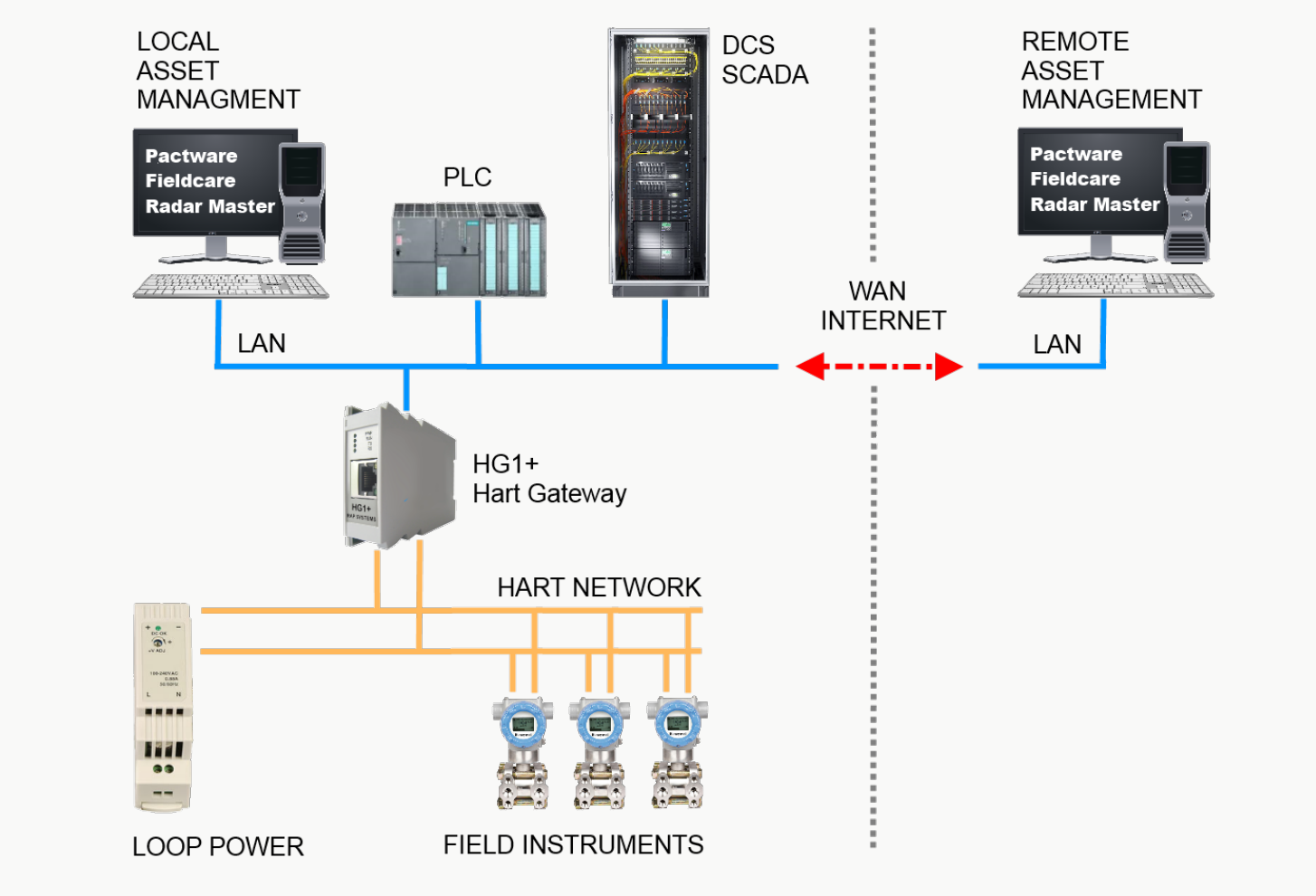
HART-to-Modbus Gateway
The HG1v4 provides an interface between instruments on a HART network and Modbus clients such as SCADA, DCS, and PLC systems. It automatically communicates with the HART devices and maintains an internal database of their configuration and process data. This data is read or written using a choice of Modbus interfaces — RS-232, RS-422, RS-485, encapsulated RTU, or Modbus TCP/IP — allowing host systems with no native HART capability to access the wide range of data available from HART devices.
Multiple Modbus connections are supported simultaneously, so transmitter data can be handed off to any number of independent consumers. The HG1v4 supports HART networks with multiple devices (multi-dropped) and may act as either a primary or secondary master. It implements all mandatory and common-practice HART commands and supports device-specific communications through installable device templates.
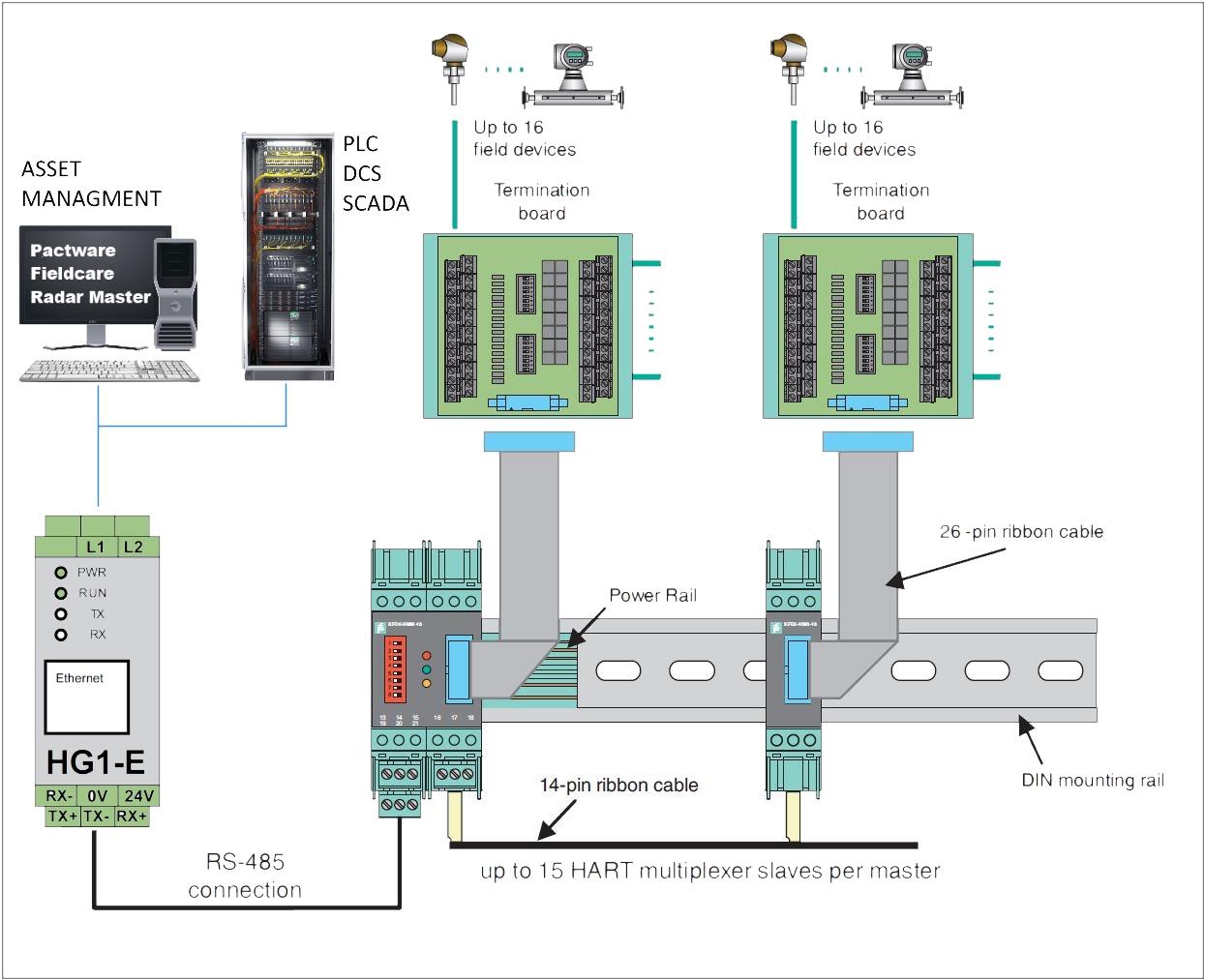
HART Multiplexer Support
The HG1v4 can also act as a HART master for a Pepperl+Fuchs KFD2-HMM-16 multiplexer system, connecting over RS-485. One HG1v4 addresses up to 16 field transmitters per gateway through the multiplexer's channel bank. The web UI's Scan Devices tool discovers what the KFD2 sees on its loops and lets you tick the transmitters you want imported; commissioning, Modbus mapping, and remote access all work the same as in standard gateway mode.
HART Modem
The HG1v4 provides a HART modem interface for industry-standard device management software such as PACTware and FieldCare. The modem is available through a direct serial connection — selectable as RS-232, RS-422, or two-wire RS-485 — and through a virtual serial port on PCs connected to the same Ethernet network as the HG1v4 (or remotely via the secure tunnel).
The HART modem may be used at the same time as the Modbus gateway, allowing both Modbus access for process control and simultaneous device management from a maintenance PC. The HG1v4 automatically and transparently arbitrates HART network bandwidth between the two applications. Unlike most HART modems, the HG1v4 does not require the host application to control the serial port's RTS signal — this is handled internally, so two- and four-wire serial standards are both supported.
Remote access
All the networked features of the HG1v4 — the web UI, HART modem, Modbus TCP communications, configuration, and firmware updates — can be accessed remotely over a local-area network or over the internet, free of charge — no subscription and no per-device fees. The integrated secure tunnel means there is no requirement to open inbound firewall ports or run a VPN: the device makes an outbound connection only, and remote access is opt-in per device.
From a single location, engineering and maintenance staff can manage and maintain field assets wherever in the world they are located. This architecture supports meaningful asset management with improved failure prediction, reduced downtime, and significant reduction in costs associated with routine and unscheduled maintenance that would otherwise require an engineer to travel to site.

Remote access is provided at no additional charge and requires no subscription. It is opt-in per device and requires the gateway to have outbound internet access. Service terms may change for future products or releases.
Configuration & tools
On-device web interface
The HG1v4 is configured entirely from a web browser — no PC software is required to set up, commission, or operate the device. Connect a PC or tablet to the same network (or directly via the link-local address printed on the label, in the form 169.254.x.x, which is unique to each gateway) and browse to the device. From the web interface you can:
- Add and configure HART transmitters, including multi-dropped loops
- Generate Modbus register maps — minimal, custom, or legacy compatible
- Commission field devices using HART configuration write-back
- Monitor live HART data and inspect Modbus traffic for diagnostics
- Apply firmware updates locally or over the air
- Export and import full device configurations for backup and cloning
PC tools (optional)
Two free Windows utilities, available from the support portal, complement the on-device web interface for engineering workflows that benefit from desktop tooling:
- HG1Discover — finds HG1v4 devices on the local network, shows their assigned IP addresses, and lets you push firmware update packages to one or many devices at once.
- HG1VspManager — presents the HG1v4's HART modem as a virtual COM port, so PACTware, FieldCare, SIMATIC PDM, and other industry-standard device management tools can talk to field devices across the network just as they would over a local USB modem.
Additional features
Open data (REST / JSON)
Beyond Modbus, the HG1v4 serves its live HART data as JSON over a simple HTTP request — locally on the network or through the secure remote tunnel. Dashboards, scripts and asset-management systems can read process values with nothing more than a standard HTTP client, with no SDK or licence required. Live readings can also be published to any MQTT broker as they change, including to AWS IoT Core and Azure IoT Hub.
Over-the-air firmware updates
The HG1v4 polls a secure download channel periodically and notifies the operator when a new firmware release is available. Updates are cryptographically signed and applied to a redundant root partition, so a failed update will automatically roll back to the previous working image without operator intervention.
Alerts
For immediate notification of problems, the HG1v4 sends an email, a webhook message (Slack, Power Automate, Node-RED, ntfy and similar), or both, when a transmitter stops responding, reports a failure or asks for maintenance (NAMUR NE 107), goes above or below limits you set on its process value, or when the gateway stops reading its HART loop — and again when each is back to normal. Alerts can also be published over MQTT.
Product support
Lawnswood Technology customers are entitled to one year of complimentary email and ticket support, including all software updates. Several levels of chargeable support are also available:
- On-site commissioning, maintenance, or upgrades
- Custom HART device template design
- Device configuration service
- System design service
- Extended ticket and email support beyond the first year
Buy online: shop.lawnswoodtechnology.com
Web: lawnswoodtechnology.com
Technical data
Computational
| Processor | 32-bit industrial ARM |
| Memory | 128 MB RAM · 512 MB flash |
| Operating system | Embedded Linux |
HART interface
| Quantity | 1 |
| Type | Primary / secondary master |
| Multi-drop | Yes |
| Multiplexer support | Pepperl+Fuchs KFD2-HMM-16 (up to 16 transmitters) |
| Loop resistance (min, ext.) | 250 Ω |
Ethernet
| Quantity | 1 |
| Type | 10/100 Base-T, RJ45 |
Serial port
| Quantity | 1 |
| Type | Software selectable RS-232, RS-422, RS-485 |
Interface protocols
| Modbus | TCP/IP, RTU, Encapsulated RTU |
| HART | Raw HART modem (serial or virtual COM port) |
| Configuration | HTTP / HTTPS web UI |
| Firmware update | Local push and OTA (signed) |
Power
| Nominal voltage | +24 V DC |
| Power consumption | < 2 W |
Connectors
| Ethernet | RJ45 |
| All other signals | 5.08 mm pitch screw terminals, accepting up to 4 mm² wire |
Mechanical
| Mounting | Snap-on DIN rail |
| Rail compatibility | DIN EN 60715 TH 35 |
| Material | Flame-retardant PA 66 (UL 94 V-0) |
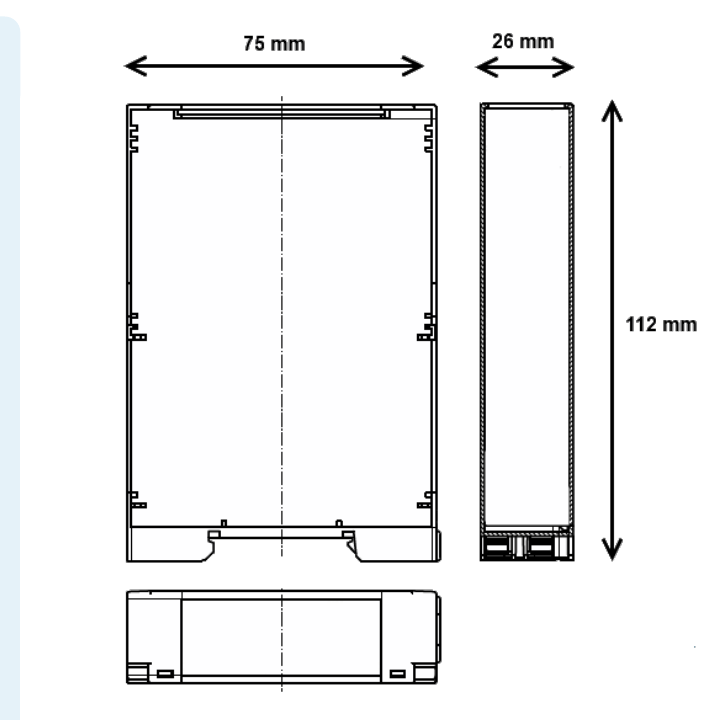
| Dimensions (W × D × H) | 75 × 26 × 112 mm |
Environment
| Operating temperature | −40 to +85 °C ambient |
| Storage temperature | −50 to +125 °C |
| Humidity | 5 to 90 % non-condensing |
| Altitude | Up to 12,000 ft (3,660 m) |
Compliance
| Europe | CE — EN ISO 17050-1:2004 |
| United Kingdom | UKCA |
| USA | FCC Part 15 (Class A) |
| Canada | ICES-003 |
| Cybersecurity | Designed to meet EU CRA & IEC 62443 (see Manual) |